2/28/23
CanMEDS and Planetary Health: How to train a doctor
. . . although I’m obviously in favour of any efforts to educate physicians about Planetary Health, the inclusion of a lecture on the topic at a CanMEDS conference doesn’t seem quite right to me. It feels a bit like sticking a band-aid on the CanMEDS framework.
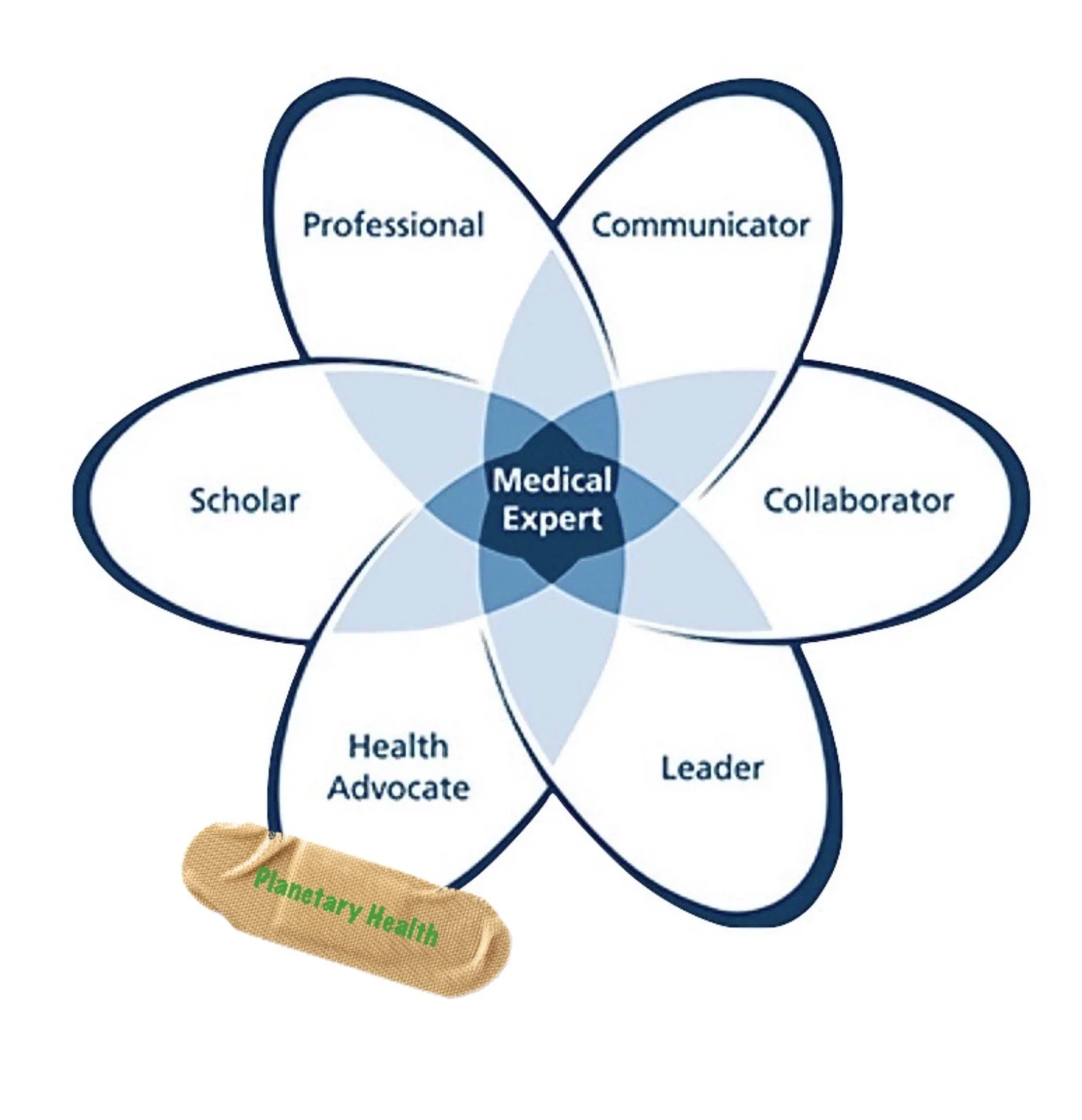
CanMEDS and Planetary Health: How to Train a Doctor
Written By Elaine Blacklock
Originally published in The Sudbury Star and elsewhere Jan. 22, 2023 https://www.thesudburystar.com/opinion/columnists/blacklock-how-to-train-a-doctor-in-planetary-health
Last September, I drove to Kingston to give a presentation on Planetary Health to a gathering of fourth and fifth year post-graduate doctors training in the specialty of respirology. (For those not in the know, respirologists deal with lung ailments like asthma and COPD.) The youngish docs in my audience were from training programs across Ontario. This was their annual CanMEDS conference, and I was their dinner-time speaker.
CanMEDS is a training framework, complete with a nifty visual resembling a flower, that describes the attributes and abilities of an effective physician. According to the model, competent physicians will behave in a professional manner. They will exhibit scholarship, and be skilled in communication, collaboration, leadership, and health advocacy. The centerpiece of the CanMEDS model is the integrating role known as “medical expert”. A CanMEDS conference is an opportunity for trainees to learn important aspects of being a physician, beyond mere medical knowledge. (There’s a Saturday morning session on the critical skill of OHIP billing, just for example.)
Medical educators are slowly coming to understand that global environmental issues like climate change have important implications for human health, but there is so much medical knowledge to impart, and it’s a struggle to find space in already jam-packed curriculums for a “new topic.” But although I’m obviously in favour of any efforts to educate physicians about Planetary Health, the inclusion of a lecture on the topic at a CanMEDS conference doesn’t seem quite right to me. It feels a bit like sticking a band-aid on the CanMEDS framework.
So as my audience munched on salad and other delectables, I began my presentation with a light-hearted comment: By the end of my presentation, I hope to convince you that Planetary Health is relevant to every aspect of the CanMEDS framework, including “medical expert.” Because what is Planetary Health, really? And where does it belong in the education of physicians?
In my view, Planetary Health is fundamentally a way of thinking; it starts with understanding that we are rapidly and seriously damaging our planet to the detriment of our own health and safety. From there, it’s easy enough to arrive at some implications for medical training. Physicians need to:
1) understand the many physical and mental health threats that arise from climate change and environmental degradation, and the dramatic health co-benefits of action to mitigate the damage;
2) recognize that the health care system itself is a substantial contributor to greenhouse gas emissions, air pollution, and other environmental damage; that this is harming the health of our patients, our communities, and people everywhere; that it’s our responsibility to consider the environmental impact of the clinical decisions we make, and work towards and advocate for sustainability;
3) stop imagining Planetary Health as an optional band-aid crazy-glued on to the CanMEDS framework; instead envision the entire teaching framework steeped in Planetary Health principles;
4) Practice our vocation, and teach our trainees, and care for our patients, with all this in mind.
My youthful audience in Kingston finished their dinner and listened to the remainder of my 1.5 hour presentation with relatively rapt attention (I could see only one cell phone in active use), and asked the inevitable question: what can we do? I explained my “three P’s” of action: Personal, Professional, and Political. And I wondered: Would their thinking be transformed at all? Would anything I’d taught them “stick”? Would they make changes in their practices? Would they pass on what they’d learned to more junior trainees? Would any of them become advocates or even activists? And above all, would this be their only exposure to Planetary Health during their two years of respirology training? Unfortunately, it might well be.
But the times they are a-changing, and at NOSM University, the new Class of ’26 were exposed to Planetary Health during their very first weeks of medical school! Now the work begins.
Overshoots and Shortfalls on Planet Earth
Massive overshoots of planetary boundaries while so many people still live poorly in so many ways? Surely, there must be a way to live safe, healthy, happy lives on this planet without simultaneously wrecking it?
Originally published in the Sudbury Star
In a world where even pets are obese, we humans still struggle to end hunger. About 830 million adults and children around the world (about one in ten) are undernourished, lacking enough food to sustain their lives and health. Many more people are malnourished, subsisting on diets deficient in specific nutrients like protein, minerals, or vitamins.
At the same time, around the world, about one in four adults is overweight or obese. The typical diet of high income countries like Canada and the USA poses a greater risk to health than unsafe sex, alcohol, drugs, and tobacco combined. As obesity rates rise, so too do the complication rates. Diabetes rates have doubled globally over the past thirty years. The costs to both individual health and health care systems are enormous.
It would be safe to say that humanity is not doing a particularly good job of feeding itself.
And there are so many other shortfalls. Plenty of people on this Planet lack access to basics like clean drinking water, clean air, adequate shelter, education, health care, jobs, safety, security, equity, justice, or a voice in their society. Some of those people live right here in Northern Ontario.
Meanwhile, our eating habits and agricultural practices alone are causing serious harm to the planet that nourishes us. We’re chopping down rainforests, destroying the planet’s soil, and killing our lakes, rivers, and oceans with chemical fertilizer, just to feed ourselves what is often a poor quality or inadequate diet that’s making us sick.
There is no way around the reality that our current human population of almost 8 billion people is impacting and changing the planet, mostly in destructive ways. It’s worth considering how much planetary derangement we can get away with before it starts to endanger our own health and safety.
Humans have of course been damaging the planet for eons. However, in the past there were far fewer of us, and we were mostly limited to destroying things at a local level. Since the industrial revolution, we’ve become much more numerous, and with the help of technology, we’re capable of altering the functioning of the entire planet. Climate change is perhaps the best known example of the change we’ve wrought, but it’s not the only planetary boundary we’ve crushed in just the last few decades.
In 2009, a group of researchers at the Stockholm Resilience Centre published a paper in the Journal Nature called : “A safe operating space for humanity.” They started by identifying nine sectors of global human impact on the planet. Here are five of them:
1) Climate change due to human emissions of greenhouse gases
2) Accumulation of novel pollutants e.g. PLASTIC
3) Land-use change: e.g. Cutting down rainforest to feed cows
4) The Biosphere: dwindling ecosystems and species, both plant and animal
5) Flows of Nitrogen and Phosphorus: too much (fertilizer) in the wrong places
For each sector, the researchers attempted to estimate the boundaries beyond which we continue to alter the planet to our peril. And then of course, where we’re at with regard to that boundary. The work is ongoing, but as the data pours in, it’s becoming clear that for the five sectors I’ve listed above, we’ve long since overshot the boundaries. We’re well outside of anything that could be considered a safe operating space on Planet Earth for ourselves, our children and grandchildren, our friends and neighbours, our fellow Canadians, and our fellow humans the world around. (And in the case of health professionals, our patients).
Massive overshoots of planetary boundaries while so many people still live poorly in so many ways. Surely, there must be a way to live safe, healthy, happy lives on this planet without simultaneously wrecking it? I will address this further in my next column.
If you want to know more about planetary boundaries, check out https://www.stockholmresilience.org/research/planetary-boundaries/the-nine-planetary-boundaries.html
If I were an American fetus . . .
if I were an American fetus, I’d ponder whether something like this could happen in Canada. I’d argue that it makes no sense to fight for life then display little regard for its wellbeing. I’d ask whether cherishing life shouldn’t also involve protecting it from health threats like air pollution and climate change. And I’d plead for a healthy planet, because I want to do more than just live. I want to thrive.
If I were an American fetus, I’m pretty sure I’d find last week’s US Supreme Court rulings confusing. On the one hand, the fractious Justices voted for my right to live. On the other hand, just days later they turned around and voted to increase my chances of growing poorly, of being born before I should be, and even of dying before I’ve had the chance to be born. Assuming I survive pregnancy and the frightful experience of delivery, those Justices have increased my chances of getting sick or dying from pneumonia or asthma before I even start school, and of dying before my time from some nasty chronic condition like diabetes, chronic lung disease, heart disease, a stroke, or lung cancer. And finally, as if all the detrimental effects of higher air pollution levels aren’t enough, those Justices have also made it more likely I’ll end up injured, sickened, maimed, emotionally scarred, or even killed by the fallout of climate change. How did they do all this? By limiting the regulatory powers of our Environmental Protection Agency.
Doesn’t it seem rather contradictory? Mind you, I’m not even born yet, so what do I know? But you might think their interest in my life would extend to some concern for my long term health and safety.
If I were an American fetus, my Canadian comrades in utero would probably find my rant puzzling. How, they might ask, can all this be? Well, let me explain. In 2021, my country (the land of the free and the home of the brave) was still producing 61 percent of its electricity by burning fossil fuels. It’s a dirty way to supply the grid, and it’s terribly bad for my health, especially when the fossil fuel in question is coal. Burning coal produces some of the worst smog on the planet, and for a little fetus like me, smog is as toxic as cigarette smoke. Air pollution starts affecting me before I even get a chance to breath. All those tiny particles and poisonous chemicals . . . wow, they can sure stunt my growth and make me think hard about abandoning the womb early. But once I’m born, I’ll just have to start inhaling the stuff myself anyway, and throughout my life, air pollution will make me less healthy than I deserve to be.
If I were an American fetus, I’d go on to explain exactly what those Justices did last week that I’m so upset about. You see, politics in my country is terribly complicated these days. On the one hand, we passed the Clean Air Act way back in 1970. That legislation has unquestionably saved the lives of a great many of the tiny ones who came before me. And now, just when we know more than we’ve ever known about the health threat of air pollution, and just when we need to boldly pursue a rapid transition to clean energy for the sake of climate stability, those Supreme Court Justices chose to make the process of cutting out fossil fuels much harder.
If I were an American fetus, I’d say their decision doesn’t make sense, and it’s not fair. My country is supposed to be a leader in the world. If the highest court in America won’t stand up and protect me from environmental harm, what hope is there for fetuses in places like India, Iran, China or Nigeria?
And finally, if I were an American fetus, I’d ponder whether something like this could happen in Canada. I’d argue that it makes no sense to fight for life then display little regard for its wellbeing. I’d ask whether cherishing life shouldn’t also involve protecting it from health threats like air pollution and climate change. And I’d plead for a healthy planet, because I want to do more than just live. I want to thrive.
Expanding our Empathy in the Anthropocene
Now, there are 8 billion of us, and we’re capable of damaging the planet not just locally, but on a planetary scale. In fact, humans are now the dominant force for change in the biological, chemical, and geological processes of Planet Earth. That’s why we’ve named this new epoch after ourselves: the Anthropocene, from the Greek anthro for “man”, and cene for “new”. Yes, we humans are making everything new, but not necessarily better.
First, if you’re not familiar with the Anthropocene, it’s the new geological epoch we’ve entered. We’ve left the Holocene, that delightful 10,000 years when we could more or less assume that important things like sea level, snow/rainfall, and seasonal temperatures were going to stay more or less the same. That pleasant predictability allowed agriculture and human civilizations to blossom. Our global population grew, as did our technologic prowess, and we began to damage the air, water, and soil wherever we lived. Then we discovered fossil fuels, a rich and portable source of energy, and both our numbers and our capacity to alter our environment grew rapidly.
Now, there are 8 billion of us, and we’re capable of damaging the planet not just locally, but on a planetary scale. In fact, humans are now the dominant force for change in the biological, chemical, and geological processes of Planet Earth. That’s why we’ve named this new epoch after ourselves: the Anthropocene, from the Greek anthro for “man”, and cene for “new”. Yes, we humans are making everything new, but not necessarily better.
And what is empathy? It’s the ability to understand and share the feelings of another. We can usually manage empathy when the “other” is someone close to us, our child, our spouse, our parents and siblings, for example. Most of us also feel and express empathy in a wide array of other circumstances. Some random child with a skinned knee; media photos of a hungry mother and infant in Sudan; news of oppressed women in Iran; images of starving polar bears in the Arctic . . . even some stranger we encounter in the lineup at Starbucks, whose spouse is dying, can arouse us to care.
What seems to be harder for us is feeling empathy at a global level, or beyond the present as we experience it. But now that we’re capable of permanently altering the entire planet, not only for ourselves, but for all humans, present and future, we desperately need to expand our capacity for empathy. It is no longer enough to care only for those within our circle, our tribe, our community, or even our nation. And it’s no longer enough to care only for the moment, the week, the year, or even the decade. In the Anthropocene, we must answer to all of humanity, to all life on this planet, and to future generations. We created this challenging new reality, and it requires us to grow our capacity to care, and manifest that care in our actions.
Let me offer two examples. The first is very individual and close to home. Remote car starters! Out on my street, the SUVs and light trucks have been idling in driveways for 15-20 minutes each morning, in -1C weather. What’s that got to do with empathy? Well, the idling might be out of consideration for the short-term comfort of a loved one. We humans can be nice people. But what about the air pollution and greenhouse gases coming out the tailpipes? Those are contributing to the ill health of the community, and to the climate crisis, which is harming people all over the planet, now and into the future. Caring about all that requires expanded empathy.
And what of COP27, which drew to a close in Addis Ababa last Monday? Believe it or not, the 27-year-old COP process has yet to produce a clear statement about the need to phase out fossil fuels. And what’s that got to do with empathy? It’s about our failure to care, at the national and political level, about the harm we’re doing to other people and other species in other places, both right now and in the future.
That future, by the way, is not eons from now. It’s the future our children are and will be living in.
Health, Safety, and Canada’s Contribution to Decarbonization
The 2020s are the make-or-break decade for decarbonization. The choices we make over the next 8 years will determine the stability of earth’s climate systems. It’s our own health and safety that are at stake. Our governments need to hear from us.
At the Rio Earth Summit in 1992, the bulk of the world’s nations came together and agreed to prevent “dangerous” interference with the earth’s climate systems. It took another thirteen years to agree on a definition of dangerous. In 2005, that looked like anything more than 2°C of global heating. The definition has since been revised; it’s become apparent that 2°C of temperature rise is significantly more dangerous than 1.5°C, and even that isn’t looking so safe anymore.
Now “safety” is the opposite of dangerous, and if you’ve been reading my recent columns, you will recall that I’ve focused in on how we might apply the research regarding patient safety in hospitals to the task of improving the prospects for human safety on Planet Earth.
Safety is not exactly the same thing as health, but as way too many people have learned through traumatic life experiences, it’s difficult to be healthy if you are physically or emotionally unsafe. Last time I was in the UK, London subways featured signs reminding travellers to “Mind the Gap”, ie. the gap between the platform and the train. Gaps can be dangerous, and we’ve got some very serious gaps to mind when it comes to climate change.
The first dangerous gap we face is between what science requires, and what the world’s nations are currently pledging to contribute to the decarbonization process. Such pledges are referred to as Nationally Determined Contributions or NDCs.
Physics and math are uncompromising disciplines. You really can’t bargain with them. Science dictates what’s required to prevent the planet’s overall temperature from rising into the dangerous range. There are direct connections between the our emissions of greenhouse gases, the levels of of those gases in the atmosphere, and the amount of heating we provoke. We know what’s required to limit temperature rise, and it involves a rapid and virtually complete decarbonization of the global economy. Based on pledges that arose from COP26 last November, we might just manage to keep warming below 2°C.
However, there’s a second gap to consider. It’s easy enough for governments to make pledges, but quite another thing to contend with the powerful vested interests of the fossil fuel industry and other stakeholders, not to mention the whims of voters. Based on the actual policies being implemented by governments around the world to date, we are headed into much more dangerous territory: at least 2.7°C, and possibly as much as 3.6°C of heating. The impacts on human health and safety will be catastrophic.
Canada is a small country, population-wise, and we’re responsible for about 1.5 percent of global emissions. Some would see this as an excuse for inaction. However, we’re near the top of the charts when it comes to per capita emissions, at 15.2 tonnes per person per year, thanks to our relatively affluent lifestyles and our fossil fuel industry. (Compare with USA: 14.4; China: 7.1; UK: 5.1 tonnes.)
Last fall, Canada updated its NDC, pledging to reduce our country’s emissions by 40-45 percent below 2005 levels by 2030, and to reach net zero by 2050. Laudable goals, no doubt, and rated as “almost sufficient” by Climate Action Tracker (CAT). However, in terms of actual policies and actions, our country is helping push the world towards an extremely dangerous 4°C of warming. That gets us a rating of “highly insufficient”, and puts us in the company of China, Australia, Brazil, Egypt, and Saudi Arabia.
By way of comparison, the USA gets a merely “insufficient” rating and the UK scores an “almost sufficient”, for policies and actions put in place to date.
The 2020s are the make-or-break decade for decarbonization. The choices we make over the next 8 years will determine the stability of earth’s climate systems. It’s our own health and safety that are at stake. Our governments need to hear from us.
Planetary Health, Planetary Safety . . . and Your Vote
Meanwhile, here in Canada, our national emissions remain substantially higher than in 1990, and our health care systems are only just beginning to think about sustainability. Our provincial leaders do battle over the carbon “tax”. And the planet gets hotter. Less safe. Less healthy.
Keep all this in mind when you vote.
In the early 1990s, we humans decided it would be a good idea to prevent “dangerous” interference with the planet’s climate. In 2005, our scientists got together and agreed that “dangerous” meant a global temperature rise of 2C or more. Then in 2018, the IPCC warned us that anything more than 1.5C of heating would be neither safe nor healthy, and not just for polar bears, but for us humans. That prediction is proving true, as the surviving citizens of British Columbia can testify after the many disasters of 2021.
As I mentioned in a previous column, health care systems have learned a great deal about how to keep patients safe in hospitals. Strategies that put the onus on fallible humans are the least effective. Policies and procedures, while annoying, can work somewhat better. Pre-printed order sets. Mandatory checking. Double checking. Pre-op checklists. All this checking and redundancy helps protect patients from human and system errors.
But whether we humans (and especially we physicians) like it or not, what works most effectively to keep patients safe are strategies that may feel like constraints to our “freedom”. Computer automation. Rules. A range of other unavoidable mechanisms designed to jar us out of autopilot and into active thinking mode. In other words, forcing functions.
The problem with “forcing” people is that it tends to bring out that almost universal human tendency towards a condition well-known to pediatricians: oppositional defiant disorder. Since Health Sciences North issued a safety edict against many of the traditional short forms used in order writing, I’ve been tempted to feel personally affronted every time I’m required to write out the word “Discharge” instead of D/C. Sounds like a small thing, right? But that’s the way we humans are.
In the 21st century, we’re facing many threats to our health and safety. The pandemic is an obvious one. But festering in the backdrop are the slower-moving and ever more dire threats of climate change and other global environmental issues of our own making. Every day, there are news reports on how global heating is sickening and killing people, either directly through floods, storms, and heat waves, or indirectly through impacts on food security, fresh water supplies, and political stability. Just this morning, I read that extreme heat waves are now 100 times more likely in already-very-hot India.
Given the threats, you’d think we’d all be taking urgent action to reduce greenhouse gas emissions, for the sake of our own health and safety. You’d think individuals, small businesses, large corporations, and governments the world around would educate themselves, recognize the dangers, and do everything possible to reduce their environmental impact. And you’d think that health professionals, whose very vocation is health, would be at the forefront of action. And yet, despite the ongoing pandemic, global emissions in 2021 were the highest ever in (human) history, and our health care systems keep pumping out between 4 and 10 percent of those emissions.
If we’re going to turn this around, we can’t just rely on good will and education. We need forcing mechanisms. Action has to start at the top, with gutsy governments willing to not only proclaim long term targets, but also to set legally binding, short term emissions budgets, then put in place the required policies and procedures. This actually happened in the UK. As a result of their 2008 Climate Change Act, UK emissions in 2019 were 45 percent below 1990 levels. Between 2007 and 2017, the National Health Service reduced its carbon footprint by 18.5 percent.
Meanwhile, here in Canada, our national emissions remain substantially higher than in 1990, and our health care systems are only just beginning to think about sustainability. Our provincial leaders do battle over the carbon “tax”. And the planet gets hotter. Less safe. Less healthy.
Keep all this in mind when you vote.
Protecting safety: forcing functions
. . . constraints and forcing functions have given us great things like universal seatbelt laws, more fuel-efficient vehicles, and a recovering ozone layer. It’s time to put them to work on the drastic emissions reductions we require at this late stage of the game.
If your handwriting is messy and hard to read, you should probably be a doctor, or so I’ve heard. The illegibility of physician handwriting is legendary. I like to think my own penmanship has stood up fairly well. Back in the day, when I was a med student, and then a resident, we routinely handwrote seven-page admission notes, often several a night. It was an excellent recipe for turning even the finest calligraphy into illegible scribbles, and that scribbling often carried over into the writing of admission orders and prescriptions. To make matters worse, drugs have both generic and trade names, many of them weird. The names of drastically different drugs often look or sound similar. And physicians make use of multiple traditional abbreviations to save time. It’s all an recipe for dangerous errors.
In high-income countries like Canada, about 1 in 10 patients admitted to hospital are harmed in some way by an adverse event. Nearly half of such events are preventable, and a high proportion of them are medication-related. (Fortunately, amputation of the wrong leg is uncommon.)
Patient safety is a high priority at hospitals these days. And fortunately, there’s good research to help protect the hapless admittee. You might think that better education of health professionals would be a good place to start. Handwriting lessons, perhaps, for the med students. Specialized training in scrawl-decoding and math refreshers (with an emphasis on fractions and decimals) for nurses. Lunch and Learn sessions on look-alike-sound-alike drug names. Educational rounds on safe order-writing. Unfortunately, such strategies are not very effective. They lack leverage, and rely on fallible humans, who have a perverse tendency to function on autopilot.
Pediatrics is particularly challenging. Our patients range in size from one-pound prems to man-like teens. Thankfully, pharmacists and nurses are on hand to double check every drug dose. Preprinted order sets promote consistent and legible management of common conditions like asthma. Operating rooms feature mandatory checklists. And should you find yourself at the hospital, you may start to wonder about your own identity, after being asked to re-confirm it for the fiftieth time. Such strategies are modestly effective in reducing errors.
However, when it comes to making real change, it’s high-leverage tools that work best. Things like computer automation, constraints, and forcing functions, designed right into the system. For example, if you want doctors to stop using a specific drug (potent greenhouse gas desflurane comes to mind), you could try educating them to choose wisely. However, forcing functions and constraints will be far more effective: Require a pharmacist to intervene and ask questions. Make docs trek to the hospital basement to retrieve the drug (good luck.) Remove said drug from the hospital formulary (or better, from the entire country.) Unfortunately, like all of us, doctors get their backs up when feeling forced or constrained.
Climate change is one of this century’s greatest safety concerns, and here’s what makes it hard to reign in: Education of individuals, corporations, and governments doesn’t produce the the kind of emissions reductions required to prevent dangerous global heating. The world’s nations have agreed to try harder. We’ve allowed other nations to check up on us. We’ve debated those pre-printed order sets and we know what has to be done. But the moment any constraints or forcing functions (like regulations or carbon pricing) threaten our freedom to drive huge gas guzzlers or otherwise live our lives as we wish, we get our backs up, start abusing one another on social media, and slander the politicians who dare to limit our freedom.
And yet, constraints and forcing functions have given us great things like universal seatbelt laws, more fuel-efficient vehicles, and a recovering ozone layer. It’s time to put them to work on the drastic emissions reductions we require at this late stage of the game.
Yes, I am a Green Climate Alarmist!!
Two weeks ago, and a few hours after my last column came out in the Sudbury Star, I received an email from a gentleman who clearly disagrees with the basic premise of my writing and the consensus of climate scientists the world around: that climate change is happening,
Two weeks ago, and a few hours after my last column came out in the Sudbury Star, I received an email from a gentleman who clearly disagrees with the basic premise of my writing and the consensus of climate scientists the world around: that climate change is happening, that it’s having perilous consequences for human health and safety, and that our burning of fossil fuels is one of the main causes.
Apparently, I’m living in a green fantasy world and busy fomenting a green climate alarmist scam. I take no offense at the terminology, nor will I be anything other than respectful in my response. I also won’t waste time defending the basics of climate science, which at this point are settled and incontrovertible.
Interestingly, there is one point upon which I can agree with my correspondent: it would be better if Canada were not buying oil from Saudi Arabia. I would go further and say it would be better if the European Union were not buying natural gas from Russia. In fact, it would be better if no-one was buying oil, gas, or coal from anybody, because the time has come to start leaving fossil fuels where they’ve been for many millions of years: in the ground. If we don’t, we will quickly blow through the remaining greenhouse gas emissions budget determined by physics, and lock in a truly dangerous and unhealthy level of global heating. That is not a good or safe idea, if you care about your kids, or your own health.
But let me address a few other claims arising from the email.
1) The carbon tax is a green scam that’s breaking the backs of people with incomes less than $70,000. My correspondent is clearly aggrieved by the Greenhouse Gas Pollution Pricing Act. Yes, it raises the price of gas at the pump, and the cost of natural gas for heating. However, it’s also refunded each spring, and as the price on carbon rises, the refunds will also rise. Check out your Notice of Assessment from the CRA. And keep in mind that gas and other prices have also shot up south of the border where there’s no “carbon tax”, partly due to fallout from the war in Ukraine.
2) Canada contributes (only) 1.6% of global emissions whereas China contributes 33% (actually 27%, but same ballpark.) Yes, China produces a lot of emissions. It also has a population of 1.4 billion people, each of whom produce less than half the emissions of the average Canadian. We have no excuse for evading responsibility.
3) Canada is already carbon neutral because our forests absorb more emission than Canada produces. This is not true. Since 2001, Canada’s forests have emitted more carbon than they’ve absorbed, making them sources of carbon, not carbon sinks. Forest fires, aggravated by climate change, are amongst the reasons.[1]
4) We can’t replace all existing vehicles with battery-powered EVs. There aren’t enough rare minerals on earth.Likely true, but that doesn’t mean we should stick with gas and diesel. We need a complete revolution in how we get around, including reduced dependence on personal vehicles, greatly enhanced and electrified public transit, and widespread adoption of active transportation, ie. burn calories, not fossil fuels. Get healthy, save money. Win-win.
5) Fossil fuel self-sufficiency is the only way for Canada to be safe from the likes of Putin and China. Sorry, but it’s only possible to make a comment like this if you reject climate science. Extracting and burning more fossil fuels is not a pathway to safety and security. On a heating planet, we will all be less safe. Less healthy. Think heat waves. Droughts. Fires. Crop failures. Floods. Destroyed infrastructure. Hunger. Migration. Conflict. War. Think British Columbia 2021, and much worse.
Am I a Green Climate Alarmist? Climate change is this century’s greatest health threat, and I’m a mom and a pediatrician. You bet I’m alarmed.
[1] https://www.nrcan.gc.ca/our-natural-resources/forests/state-canadas-forests-report/disturbance-canadas-forests/indicator-carbon-emissions-removals/16552; https://www.cbc.ca/news/canada/calgary/canada-forests-carbon-sink-or-source-1.5011490
It’s time to ditch the Standard Canadian Diet
Our food production systems are responsible for 30 percent of greenhouse gas emissions. Our increasing proclivity for animal-based sources of protein is a major driver for the expansion of agricultural land and the resulting loss of forests, especially in the tropics. Our farming practices degrade the soil, and pollute and deplete our fresh water sources. Even as the population of humans continues to rise, the population of a great many of our fellow creatures is declining drastically, due to loss of or damage to their habitats. We humans might find ways to justify our derangement of the planet if in fact we were healthier for it. But alas, we are not.
A few weeks ago, I wrote about the win-win plant-rich diet. Today I will focus on a lose-lose diet that’s become known by the acronym SAD: the Standard American Diet.
Sadly, consumption of the SAD is not constrained by the borders of the USA. Americans have exported their eating habits globally and Canada has not remained unscathed. Being a proud Canadian, I felt our all-too-typical Canadian diet should have its own name, so I’ve called it the Stan-Can.
Like SAD, the Stan-Can is characterized by a high intake of processed and animal-sourced foods like meat and dairy. It's high in salt and sugar, refined carbs, and unhealthy saturated fats, and it's clearly bad for us. Over the last few decades, our predilection for the Stan-Can has only increased, as has our tendency to be inactive. The result has been soaring rates of obesity, and diet-related chronic diseases like Type 2 Diabetes, high blood pressure, high cholesterol/triglycerides, heart disease, strokes, and many forms of cancer. In fact, our unhealthy diets pose a greater risk for illness and premature death than unsafe sex, alcohol, drugs, and tobacco combined. The Stan-Can hasn’t been so great for the planet either, and its detrimental impact is growing.
The current population of humans on Earth is almost 8 billion, and we’ll probably reach about 10 billion in number by 2050. Though we’ve managed to increase food production dramatically in recent decades, a great many people around the world are suffering from nutritional issues. The challenge before us is to learn how to feed everyone well without completely wrecking the planet.
Globally, one in ten people are undernourished, lacking access to adequate calories. As a result, some 151 million children suffer from stunted growth and 51 million are thin and wasted.
Meanwhile, these diets are also unsustainable. Our food production systems are responsible for 30 percent of greenhouse gas emissions. Our increasing proclivity for animal-based sources of protein is a major driver for the expansion of agricultural land and the resulting loss of forests, especially in the tropics. Our farming practices degrade the soil, and pollute and deplete our fresh water sources. Even as the population of humans continues to rise, the population of a great many of our fellow creatures is declining drastically, due to loss of or damage to their habitats. We humans might find ways to justify our derangement of the planet if in fact we were healthier for it. But alas, we are not.
In 2019, Health Canada released Canada’s new food guide. The guide is based on the best scientific evidence available and remarkably free from the influence of lobby groups. It offers state-of-the-art advice on how to eat well, and its simple recommendations can be adapted to serve a wide range of food traditions and preferences. Eat mostly plants. Drink mostly water. It sounds bland and boring, but a glance at the sample plate reveals the rich array of colourful, appealing options from which to choose.
Perhaps it’s surprising that a Food Guide primarily designed to promote human health turns out to be a winner for the planet too. But then again, with its emphasis on fruits and vegetables, whole grains, and plant-sourced proteins, Canada’s Food Guide is just more proof that what’s good for people can be good for the planet. And vice versa.
Sources:
1) Food in the Anthropocene: The EAT-Lancet Commission on healthy diets from sustainable food systems. The Lancet Vol. 393. Feb. 2, 2019.
2) Food Systems: seven priorities to end hunger and protect the planet. Nature 30 Aug. 2021
Sh**t ,I smoke - Air Pollution and Your Health
Cigarette smoking is a risk factor for a multitude of lethal health conditions. Smokers are often miserably short of breath. They also look older and die younger. So it might be disturbing to learn you can download an app that converts the health impact of your air pollution exposure to the equivalent number of cigarettes smoked.
It’s 9 am, Wednesday Feb. 16. Sudbury’s Air Quality Health Index is already in the “moderate risk range” at 4. Based on current levels of air pollution, I’ll be smoking two-thirds of a cigarette today.
Let me be clear – I don’t smoke, and as befits a 21st century health professional, I try to convince every smoker I meet to persevere in trying to quit. Cigarette smoking is a risk factor for a multitude of lethal health conditions. Smokers are often miserably short of breath. They also look older and die younger. So it might be disturbing to learn you can download an app that converts the health impact of your air pollution exposure to the equivalent number of cigarettes smoked. Appropriately, it’s called “Sh**t! I smoke”.
In 1979, I dissected a cadaver. It was one of the less pleasant tasks required of first year medical students, but it’s a right of passage that still persists. The preserved body I shared with my three classmates was an elderly fellow who’d clearly been a smoker. When we opened up his chest cage, we saw not the dusty-rose colour of healthy lungs, but the brownish-black tarry residue of burnt tobacco, which had accumulated over many decades.
Each cigarette the man smoked also delivered a hefty dose of tiny particles, known as particulate matter or PM, to his airways and lungs, not to mention those of his wife and children, who were probably forced to breath his second hand smoke.
PM2.5 is a major component of both cigarette smoke and air pollution. Though some PM2.5 is of “natural origins,” most of it arises from burning things: fossil fuels, tobacco, firewood, cow dung, agricultural waste, forests, peat bogs, garbage, and other industrial nastiness. Some particles are emitted directly through burning, or kicked up into the atmosphere by human activities like driving or construction. Others are formed in the atmosphere through chemical reactions between toxic air pollutants like sulfur dioxide (SO2), nitrogen oxides (NOx), and volatile organic compounds (VOCs).[1]
Airborne particles comes in an array of sizes. Larger ones, like dust and pollens, are classified as PM10. They will generally get trapped by the hairs and mucous in our noses and airways, and coughed or blown out. However, smaller ones can fly right past the defences of our respiratory tracts to reach the tiny air sacs deep in our lungs where oxygen and carbon dioxide exchange takes place. From there, they penetrate into our blood streams and organs, often carrying toxic chemicals on their backs. Suffice it to say, they are not good for us.
On a bad day in Beijing, the mathematical models used by the Sh**T! I Smoke app might cough up an equivalency of 25 cigarettes per person per day. With air that smoggy, researchers no longer have to resort to studying smokers to sort out the impact of life-threatening levels of air pollution. But perhaps Beijing’s 21 million citizens will find it reassuring that, on a more average day in their city, every man, woman, and child (and baby) only smokes four cigarettes. The U.S. average is lower, a mere 0.4 cigarettes per day. However, residents of air pollution hot spots like Toronto, Vancouver, and Los Angeles are advised not to take comfort in national averages.
Newer research suggests there’s no safe lower limit for PM2.5 exposure, whether from smoking or air pollution. The closer we get to zero, the better our health outcomes. And no sensible parent these days wants their children to smoke. Not even two-thirds of a cigarette a day. So may I suggest we stop burning stuff?
[1] Some VOCs arise naturally from vegetation, but you can also get an unhealthy dose of them by sitting in a new car.